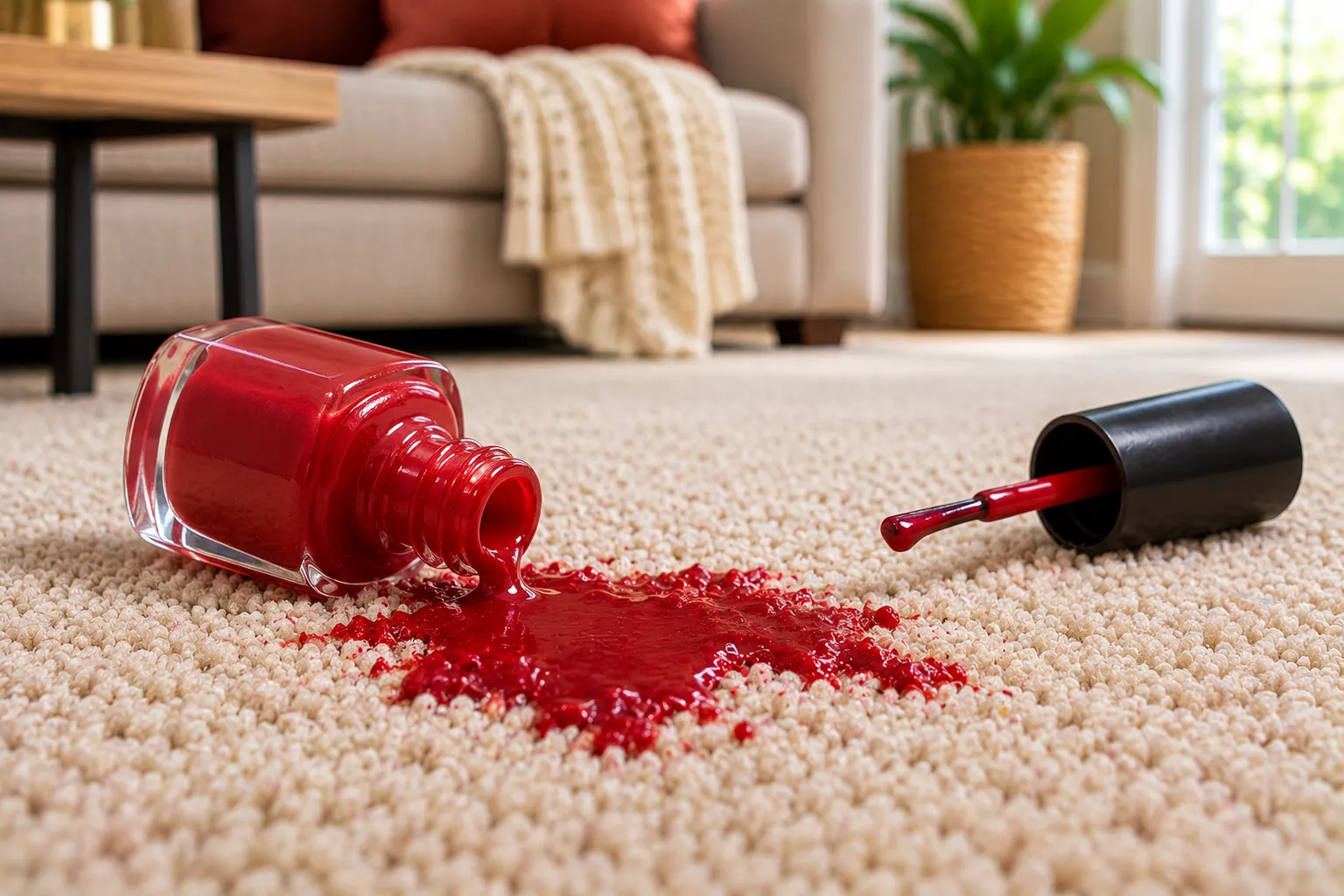
A spilled bottle of nail polish can turn an ordinary afternoon into a frustrating cleaning emergency. One moment you're painting your nails, and the next, bright red, pink, purple, or another bold color is spreading across your carpet.
Unlike many everyday household spills, nail polish is specifically designed to form a durable coating. Once it dries, it can cling firmly to carpet fibers and become difficult to remove with ordinary cleaning products.
The good news is that a nail polish spill does not automatically mean your carpet is ruined.
Depending on the carpet material, polish formulation, and how quickly you respond, it may be possible to remove or significantly improve the stain.
However, nail polish requires a different approach from common food or drink spills. Using the wrong solvent, scrubbing aggressively, or saturating the carpet can create additional damage.
If you're wondering how to get nail polish out of carpet, this guide explains what to do with fresh and dried polish, how to approach stubborn stains, which cleaning products require caution, and when professional carpet cleaning may be the safer choice.
Nail polish is formulated to adhere to a surface and create a lasting colored finish.
Traditional nail polish commonly contains film-forming ingredients, pigments, solvents, and other compounds that help it spread smoothly and harden after application.
When nail polish lands on carpet, several problems can occur.
First, liquid polish can move between carpet fibers before it dries.
Second, the pigments may leave strong discoloration.
Third, as the polish hardens, it can form a coating around individual fibers.
The difficulty of removal depends on several factors:
The first priority is to prevent the spill from spreading.
Quick action can help, but rushing into aggressive cleaning is not the answer.
Prevent anyone from stepping on the spill.
Foot traffic can spread wet nail polish across additional carpet fibers.
If a large amount of liquid polish is sitting on the carpet, use the edge of a spoon or another suitable dull-edged tool to lift excess material.
Do not push it deeper into the carpet.
Use a clean white cloth to gently blot transferable polish.
Avoid rubbing back and forth.
Rubbing can enlarge the affected area and spread the pigment.
Before applying any solvent or cleaning product, determine whether the carpet is synthetic, wool, or another material.
If possible, check the carpet manufacturer's care instructions.
Do not immediately pour nail polish remover, rubbing alcohol, vinegar, or another chemical onto the stain.
Some products may affect carpet dyes, backing, adhesives, or fibers.
A small stain can become a larger problem if the cleaning product damages the carpet.
Fresh nail polish is still liquid, which creates both an opportunity and a risk.
It may be easier to transfer before it hardens, but it can also spread quickly.
Use a spoon or clean white cloth to carefully lift and blot excess polish.
Work from the outside of the spill toward the center.
As polish transfers onto the cloth, move to a clean section.
Using a heavily stained cloth can redeposit color onto the carpet.
Pressing hard can drive the polish deeper into the pile.
Use controlled blotting.
If the affected area is becoming larger, stop.
Continuing to blot with a contaminated cloth or inappropriate product can make matters worse.
Once excess polish has been removed, use only a treatment verified as appropriate for the carpet and the stain.
Follow the product manufacturer's directions, including any spot-testing requirements.
If you are unsure whether the carpet can tolerate a solvent, professional evaluation is preferable.
Dried nail polish presents a different challenge.
Once hardened, it may form a rigid coating around carpet fibers.
Trying to pull it away forcefully can damage the pile.
Look closely at the affected area.
Determine whether the polish is sitting mostly on the surface or has penetrated deeply into the fibers.
If small pieces of dried polish separate easily, carefully lift them away.
Use a dull-edged tool.
Avoid sharp knives and razor blades.
If the polish is firmly attached, do not yank on it.
Aggressive pulling can distort or remove carpet fibers.
Repeated scraping may damage the carpet even if it removes some polish.
Dried nail polish may require specialized spot treatment.
Because the appropriate product depends on the carpet material and polish formulation, professional assistance may be safer than experimenting with multiple solvents.
This is one of the most common questions about nail polish stains.
Nail polish remover is designed to dissolve or loosen nail polish on nails, but that does not mean it is automatically safe for carpet.
Some removers contain acetone, while others use different solvents.
These chemicals may affect certain carpet fibers, dyes, finishes, backing materials, or adhesives.
Do not pour nail polish remover directly onto carpet.
Before using any solvent, verify compatibility with the carpet manufacturer's instructions and the product label.
If the carpet material is unknown, valuable, delicate, or already showing discoloration, avoid experimenting.
A professional carpet cleaner may be able to evaluate the stain and recommend a suitable approach.
Acetone can dissolve many traditional nail polish formulations.
However, it can also damage certain carpet materials and components.
Some synthetic fibers and carpet backing materials are particularly sensitive to strong solvents.
Acetone is also highly flammable.
For these reasons, it should not be treated as a universal DIY solution for carpet.
Avoid applying acetone unless the carpet manufacturer and cleaning-product instructions specifically support its use.
Keep solvents away from heat, sparks, flames, and other ignition sources.
If you are uncertain about compatibility, do not use acetone on the carpet.
If you want to avoid acetone, begin with conservative physical removal.
For fresh polish, carefully lift excess liquid and blot transferable material.
For dried polish, gently remove only material that separates without force.
Afterward, assess the remaining stain.
A carpet-safe spot treatment specifically labeled for the relevant carpet and stain may be appropriate.
However, ordinary water and dish soap may not dissolve hardened nail polish.
Do not assume that avoiding acetone guarantees complete stain removal.
Sometimes professional treatment is the better option.
Rubbing alcohol is frequently mentioned in DIY nail polish removal advice.
However, its effectiveness varies depending on the polish formulation.
It can also affect some carpet materials.
Before using alcohol, check the carpet manufacturer's care recommendations and the cleaning product's instructions.
Avoid saturating the carpet.
Do not mix alcohol with unrelated cleaning chemicals.
Remember that rubbing alcohol is flammable.
If the stain is large or the carpet is delicate, professional evaluation may be preferable.
Vinegar is commonly recommended for household cleaning, but it is not a reliable universal solvent for hardened nail polish.
Traditional nail polish forms a durable coating that ordinary vinegar may not effectively dissolve.
Repeatedly soaking the stain with vinegar can introduce unnecessary moisture without resolving the problem.
If you are considering a vinegar-based method, first verify that it is appropriate for the carpet.
Avoid mixing vinegar with bleach or other household chemicals.
Baking soda is useful in some household cleaning situations, but it is not designed to dissolve hardened nail polish.
Sprinkling baking soda over a nail polish stain will not necessarily remove the coating attached to carpet fibers.
It may also introduce additional powder that needs to be vacuumed away.
Focus first on carefully removing excess polish and identifying an appropriate treatment.
Older cleaning advice sometimes recommends hairspray for stains.
However, hairspray formulations vary considerably.
Many contain ingredients that may leave sticky residue or affect carpet materials.
Some aerosol products are also flammable.
Using hairspray may create an additional cleaning problem without reliably removing the polish.
For these reasons, hairspray is not a preferred starting method.
Red nail polish can be especially noticeable on cream, beige, and white carpeting.
The challenge is not necessarily different from other colors, but the strong pigment can make remaining discoloration more visible.
Start by removing excess polish carefully.
Avoid rubbing the red pigment into surrounding fibers.
Do not automatically use bleach.
Bleach can permanently alter carpet color and is not an appropriate general-purpose nail polish remover.
If a red stain remains after conservative treatment, professional spot cleaning may be appropriate.
Different nail polish colors may contain different pigments, but the same general precautions apply.
Remove excess material without spreading it.
Avoid aggressive scrubbing.
Do not apply strong solvents without verifying compatibility.
Dark nail polish may leave particularly noticeable marks on light carpeting.
Glitter polish can create additional cleanup challenges because small decorative particles may remain after the colored coating is removed.
Once the area is dry, vacuuming may help collect loose glitter.
Avoid vacuuming wet nail polish.
Glitter nail polish combines a film-forming polish with decorative particles.
This can create two separate problems:
Begin by addressing the polish itself.
Do not aggressively scrape or pull fibers.
Once the area is completely dry and any loose particles have separated, vacuum carefully.
If hardened glitter polish remains embedded, professional spot treatment may be necessary.
Gel nail polish products vary.
Some are designed to cure under UV or LED light, while others are marketed as gel-like polish without requiring a curing lamp.
Their ingredients and removal requirements can differ.
Do not assume that a method used for ordinary nail polish will work on every gel product.
If possible, identify the specific polish involved.
For a large or hardened spill, professional advice may be preferable to applying strong chemicals.
A bright nail polish stain on white carpet can look especially alarming.
However, white carpet should not automatically be treated with bleach.
Some white carpets contain dyes, finishes, or fibers that can be damaged by bleaching agents.
Start with careful physical removal.
Avoid spreading the pigment.
If the stain remains, choose a treatment specifically compatible with the carpet.
Professional stain removal may help reduce the risk of creating a permanent discolored patch.
Wool carpet requires extra caution.
Natural fibers may respond differently to solvents, moisture, and mechanical agitation than common synthetic carpeting.
Avoid aggressive scraping.
Do not assume that a nail polish remover suitable for nails or another household surface is appropriate for wool.
For valuable wool carpeting, professional evaluation is generally the safer option.
Area rugs vary significantly in construction.
A machine-made synthetic rug may tolerate cleaning methods that are unsuitable for handmade, antique, wool, or specialty-dyed rugs.
If nail polish spills onto an area rug:
Preserving the rug's fibers and dyes is more important than attempting an unverified DIY treatment.
Several common mistakes can turn a small stain into permanent carpet damage.
Scrubbing can spread liquid polish and damage carpet fibers.
Strong solvents may damage fibers, dyes, backing, or adhesives.
Bleach can permanently alter carpet color.
Combining household products can create safety risks.
Knives and razor blades can cut carpet fibers.
Excessive liquid can spread contamination and affect underlying materials.
Heat can affect some carpet fibers and create additional risks when flammable solvents are present.
If one treatment fails, repeatedly adding different chemicals may create additional damage.
Sometimes the hardened polish disappears, but a colored mark remains.
This can happen when pigments or other ingredients have affected the carpet fibers.
Another possibility is that small amounts of polish remain attached to the pile.
The stain may also become more noticeable after the carpet dries.
If the physical polish has been removed but discoloration remains, avoid repeatedly applying stronger chemicals.
Professional evaluation may help determine whether further improvement is possible.
Yes.
Some nail polish spills can cause permanent discoloration or fiber damage.
The outcome depends on:
Prompt and careful treatment may improve the outcome, but complete removal cannot be guaranteed.
Professional carpet cleaners may be able to improve or remove certain nail polish stains using appropriate spot-treatment methods.
However, nail polish is different from ordinary soil.
Routine carpet cleaning alone may not dissolve hardened polish.
Specialized stain treatment may be necessary, and some stains may remain permanent.
A responsible cleaning professional should evaluate the affected area before promising a particular result.
If possible, provide the polish brand or product information.
Also explain which household cleaning products have already been used.
Nail polish is only one of many substances that can leave stubborn marks on carpet.
Makeup, paint, coffee, food spills, pet accidents, and other household stains can require different cleaning approaches.
When careful DIY cleaning does not resolve the problem, professional carpet cleaning may be the next step.
Sani-Kleen of Savannah LLC has provided carpet-cleaning services throughout the Savannah area since 2003.
Our services include residential carpet cleaning, commercial carpet cleaning, sanitizing and odor elimination, upholstery and furniture cleaning, and area rug cleaning.
We use eco-friendly, fast-drying cleaning methods designed to refresh carpets without unnecessarily long drying periods.
If you have a stubborn nail polish stain, contact Sani-Kleen to discuss the affected area and available cleaning options.
Preventing a spill is easier than removing hardened nail polish.
Choose a table, desk, or another stable surface instead of painting directly over carpet.
Place a washable protective mat beneath your manicure area.
Avoid leaving open nail polish bottles near the edge of a table.
Replace the cap when the polish is not being used.
Store nail polish securely to reduce accidental spills.
Fresh polish may be easier to manage before it hardens.
Bedrooms and dressing areas often collect more than nail polish stains.
Common sources of soil include:
Regular vacuuming helps remove loose debris.
Prompt spot treatment can reduce the likelihood of stubborn stains.
Avoid excessive detergent and harsh chemical mixtures.
Periodic professional carpet cleaning can help maintain the overall appearance of carpeting.
For fresh polish, carefully lift excess liquid and blot transferable material without rubbing. For dried polish, gently remove loose material and use only a treatment verified as compatible with the carpet.
Carefully lift dried material that separates easily. Avoid aggressive scraping or pulling carpet fibers. Deeply embedded polish may require professional spot treatment.
It can. Some nail polish removers contain strong solvents that may affect carpet fibers, dyes, backing, or adhesives.
Acetone can damage certain carpet materials and is highly flammable. Do not use it unless the carpet manufacturer's guidance and product instructions specifically support the application.
Begin with careful physical removal and use only carpet-compatible spot treatments. Some hardened polish stains may require professional assistance.
Vinegar is not a reliable universal remover for hardened nail polish.
Baking soda does not reliably dissolve hardened nail polish and should not replace appropriate stain treatment.
Professional treatment may improve or remove some nail polish stains, but results depend on the polish, carpet material, stain age, and previous cleaning attempts.
Consider professional assistance when:
The goal is to remove or improve the stain without causing additional carpet damage.
If nail polish, makeup, paint, food spills, pet accidents, or other stubborn stains have left your carpet looking less than its best, Sani-Kleen of Savannah LLC can help.
We provide professional carpet cleaning throughout Savannah and surrounding communities, including Pooler, Richmond Hill, Port Wentworth, Garden City, Wilmington Island, Tybee Island, Rincon, Springfield, Guyton, and Skidaway Island.
Sani-Kleen has served the area since 2003 and offers eco-friendly, fast-drying carpet-cleaning services.
Whether you're dealing with stubborn stains, pet odors, or everyday dirt, contact our team to discuss your cleaning needs and request a quote.
Call Sani-Kleen of Savannah at (912) 414-0652 to request a quote or schedule professional carpet cleaning.