.png)
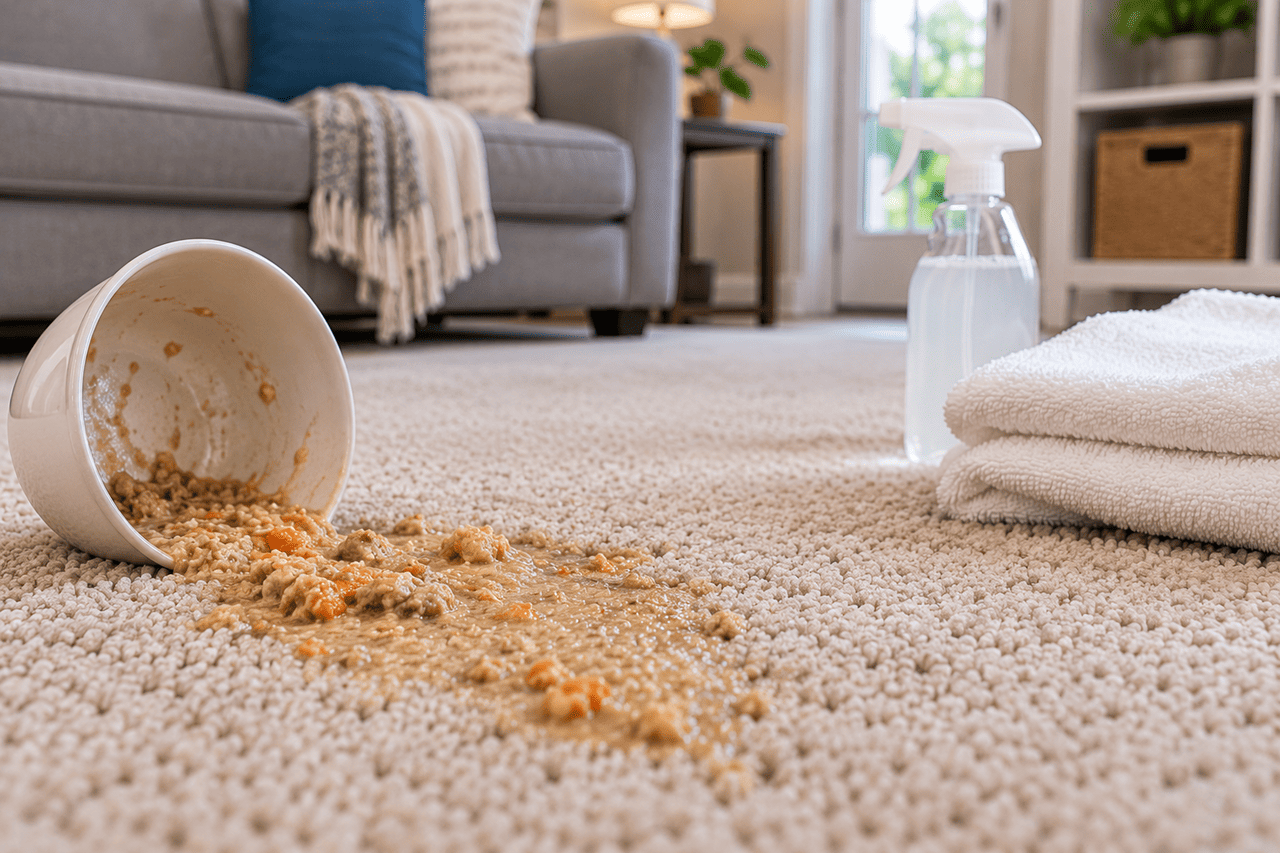
Vomit is one of those carpet messes nobody wants to deal with, but waiting usually makes the cleanup harder.
Whether the accident comes from a sick child, an adult, or a pet, vomit can leave behind more than an unpleasant mess. Liquids can soak into carpet fibers, solid material can become trapped between them, and pigments from food or drinks can leave a visible stain. Even after the carpet looks clean, an unpleasant odor may remain.
The best approach is to act promptly without aggressively scrubbing or saturating the carpet.
If you are wondering how to get vomit out of carpet, the process involves three main goals: removing the solid material, cleaning the affected carpet fibers, and addressing any remaining odor or discoloration.
Here's how to approach the problem safely.
Carpet has a textured, absorbent surface, which makes this type of accident more complicated than cleaning a hard floor.
Vomit can contain a mixture of liquids, partially digested food, coloring, and other organic material. Instead of remaining entirely on the surface, moisture can work its way between carpet fibers.
The longer the mess remains, the more difficult it may become to remove.
Potential problems include:
Prompt cleanup can reduce the chance that a relatively small accident becomes a persistent carpet problem.
Before reaching for a carpet cleaner, remove the physical material first.
Do not begin by rubbing the entire area with a wet towel.
That can spread the mess farther into the carpet.
Use disposable gloves when cleaning bodily fluids or animal vomit.
Keep children and pets away from the affected area while you clean.
If appropriate, open a window or improve ventilation in the room.
Carefully lift away solid material using paper towels, a disposable scraper, spoon, or another suitable dull-edged tool.
Work from the outside toward the center.
Try to lift the material upward rather than pushing it into the carpet.
Place waste directly into a disposable bag.
Once the solid material is gone, place clean white towels or plain white paper towels over the wet area.
Blot firmly.
Replace saturated towels as needed.
Avoid rubbing from side to side.
The objective is to transfer moisture from the carpet to the towel.
Once you have removed as much material and moisture as possible, look at what remains.
You may still have:
You can then move to controlled cleaning.
For compatible synthetic carpet, a mild cleaning solution may help after the physical material has been removed.
You will need:
Add a small amount of dishwashing liquid to water.
Do not make the solution excessively soapy.
Apply a small amount to a clean cloth rather than pouring it directly onto the carpet.
Blot the affected area.
As material transfers onto the cloth, switch to a clean section.
After cleaning, use another cloth lightly dampened with clean water to help remove remaining detergent.
Then blot the carpet with dry towels.
Avoid saturating the area.
When an unpleasant accident happens, the natural reaction is often to scrub hard.
That can be counterproductive.
Scrubbing may:
Blotting provides more control.
For trapped solid material, carefully lifting it is preferable to grinding it into the carpet.
Sometimes the carpet looks clean but the room still smells unpleasant.
This can happen if odor-producing residue remains in or below the carpet fibers.
Simply spraying fragrance over the area may temporarily cover the smell, but it does not necessarily remove the source.
Before reaching for deodorizer, inspect the carpet carefully.
Any remaining organic material needs to be removed.
Adding large amounts of scented liquid may make the carpet smell different temporarily while creating a wetter area that takes longer to dry.
A carpet-safe product designed for organic stains and odors may be appropriate.
Follow the manufacturer's instructions carefully.
A damp carpet can smell different from a fully dried carpet.
Give the cleaned area adequate airflow and drying time before evaluating the final result.
If a strong odor remains after the carpet has dried, additional treatment may be necessary.
A dried accident can be more difficult because solid material may become attached to carpet fibers.
Do not immediately begin scraping aggressively.
Use a dull-edged tool to carefully lift dried material that separates easily.
Avoid knives and sharp blades.
Once loose, fully dry material has been removed, a vacuum may help collect remaining dry particles.
Do not vacuum wet or sticky material.
For compatible carpet, controlled moisture may help soften material that remains attached to the fibers.
Use a damp cloth.
Do not pour a large quantity of water directly onto the carpet.
As the residue softens, gently blot and lift it.
Repeat gradually rather than scrubbing.
Once the physical material is gone, use an appropriate carpet-safe stain treatment if discoloration remains.
Follow the product instructions.
Sometimes the mess was cleaned immediately, but a yellow, brown, orange, or other discolored patch remains afterward.
At this stage, you are dealing primarily with a stain rather than physical vomit.
The color may be influenced by whatever food or drink was present.
For example, strongly colored foods can create a separate staining problem.
Start with a carpet-safe spot treatment appropriate for your carpet.
Test products in an inconspicuous area when recommended.
Avoid repeatedly adding stronger household chemicals if the stain does not respond.
A professional carpet cleaner may have more appropriate stain-treatment options.
Baking soda is commonly suggested for absorbing moisture and reducing odors.
It may be useful in some household cleaning situations, but it should not replace proper removal of the contamination itself.
If solid material and residue remain in the carpet, sprinkling baking soda over the top does not solve the underlying problem.
If you choose to use baking soda as part of your cleanup process, make sure the method is appropriate for your carpet and that the material is completely dry before vacuuming.
Do not combine baking soda with random chemicals in an attempt to create a stronger cleaner.
Vinegar is another frequently recommended DIY cleaning ingredient.
It may help in some situations, but it should not be treated as a universal carpet deodorizer.
Different carpets contain different fibers, dyes, backing materials, and finishes.
If you plan to use a vinegar solution, first determine whether it is appropriate for your carpet and test it in a hidden location.
Use a controlled amount.
Avoid soaking the carpet.
Most importantly, do not mix vinegar with unrelated household cleaning products.
Hydrogen peroxide can affect color, which means it requires caution when used on carpet.
Although it may appear in DIY stain-removal recipes, a product capable of altering a stain may also alter carpet dye.
This is especially important on darker or specialty carpeting.
Before applying peroxide, check whether it is appropriate for the carpet and test as recommended.
If you are unsure, choose a less aggressive treatment or contact a professional.
A carpet-cleaning product can be useful after solid material and excess moisture have been removed.
However, the correct product and method depend on the carpet and severity of the accident.
Do not immediately flood the area with shampoo.
Excess detergent can leave residue behind, and excessive moisture may move contamination deeper into the carpet.
If using a store-bought carpet stain product, follow its instructions carefully.
Using twice as much cleaner does not necessarily produce twice the cleaning.
Several common mistakes can create additional problems.
Remove solids and blot liquids instead.
Fresh accidents are generally easier to address than dried ones.
More water is not always better.
Excess moisture can spread the affected area and increase drying time.
Avoid combining different household cleaners.
Certain chemical combinations can be dangerous, and others can damage carpet fibers or dyes.
Household bleach can permanently alter carpet color and is not a general carpet stain remover.
Masking an odor is different from removing its source.
Knives and razor blades can permanently cut carpet fibers.
If the smell remains after cleaning, there are several possible reasons.
Small amounts of material may remain between fibers.
Enough liquid can potentially reach the carpet backing or padding.
Heavy detergent residue can create its own odor and soil-attraction problems.
Wait until the carpet has dried before determining whether the odor truly remains.
A fragrance may temporarily overpower the original smell.
When it fades, the underlying odor becomes noticeable again.
Yes, particularly if the accident involves a significant amount of liquid or remains untreated for an extended period.
Carpet is not a waterproof barrier.
Moisture can potentially move through the carpet and into lower layers.
A small accident cleaned promptly is different from a large accident that saturates an area.
If the smell repeatedly returns despite careful surface cleaning, deeper contamination may need to be considered.
The basic carpet-cleaning process remains similar:
Remove solid material, absorb moisture, clean carefully, and dry the carpet.
However, the person's wellbeing comes first.
Take care of the sick child before worrying about the carpet.
Once the situation is under control, wear gloves and clean the affected area.
Keep other children and pets away until the cleanup is complete.
For illness-related bodily fluids, follow appropriate hygiene and sanitation guidance rather than relying solely on ordinary stain removal.
Dog vomit is another common household carpet accident.
Begin by removing solid material and blotting remaining liquid.
If the mess contains strongly colored food, it may leave a separate stain.
A carpet-safe product designed for pet-related organic stains may be useful when applied according to its directions.
If your dog is repeatedly vomiting, carpet cleaning is not the main issue. Contact a veterinarian for advice about the animal.
The same basic principles apply to cat vomit.
Remove solids first.
Blot liquid.
Avoid scrubbing.
Treat remaining residue using a carpet-compatible cleaning method.
Cat food can contain strong coloring, so a visible spot may remain even after the physical material is removed.
If the stain persists, avoid escalating immediately to aggressive chemicals.
Area rugs require extra consideration because their construction varies significantly.
A common synthetic rug may tolerate cleaning methods that are inappropriate for:
Check the rug's care instructions if available.
Avoid saturating valuable rugs.
For delicate or expensive area rugs, professional cleaning may be safer than experimenting with household chemicals.
Wool carpet deserves extra caution.
Cleaning chemistry, moisture, temperature, and agitation can affect natural fibers differently from common synthetic carpeting.
Avoid assuming that a DIY recipe suitable for one carpet is appropriate for wool.
If you are dealing with a large or deeply embedded stain on wool carpet, professional evaluation may be preferable.
Professional cleaning can help address many organic stains and odors, but results depend on the specific situation.
Factors include:
No responsible cleaner should promise that every permanent discoloration can be completely removed before evaluating it.
If you have already applied cleaning products, tell the professional what you used.
That information can help when determining an appropriate treatment.
Accidents happen in every home.
Vomit, pet urine, spilled drinks, food, mud, paint, slime, and everyday foot traffic can all leave carpet looking or smelling less than fresh.
When a stubborn stain or odor remains after careful home cleaning, professional carpet cleaning may be the next step.
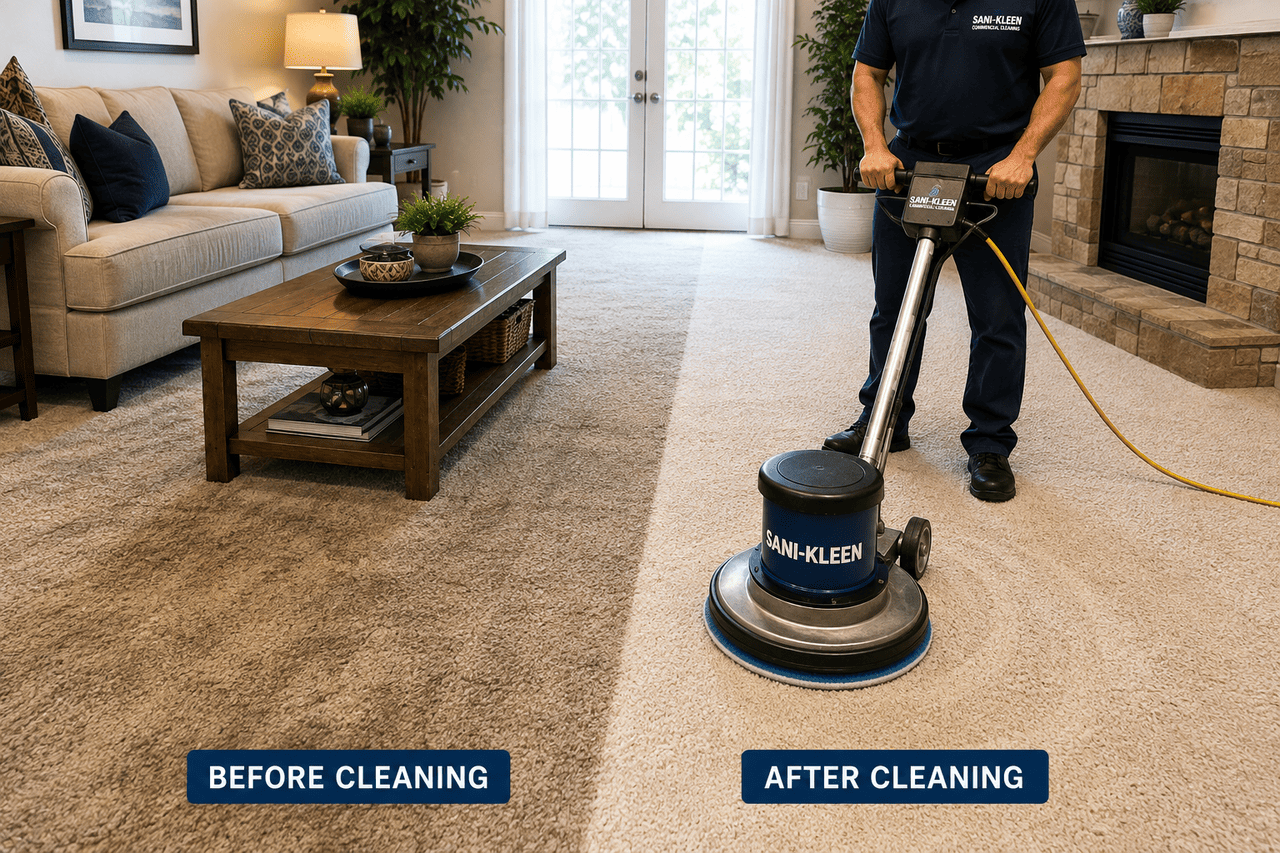
Sani-Kleen of Savannah LLC has provided carpet cleaning services throughout the Savannah area since 2003.
Our services include residential carpet cleaning, commercial carpet cleaning, sanitizing and odor elimination, upholstery and furniture cleaning, and area rug cleaning.
We use eco-friendly, fast-drying cleaning methods designed to help refresh carpets without unnecessarily long drying periods.
Once the immediate problem is resolved, basic carpet maintenance can help keep the room looking better.
Routine vacuuming removes loose soil, hair, crumbs, and debris before they accumulate.
The sooner you address a new spill, the less opportunity it has to spread or dry.
Clean white towels, disposable gloves, and an appropriate carpet-safe spot cleaner can make emergency cleanup easier.
More soap does not equal cleaner carpet.
Residue can attract soil and make treated areas look dirty again more quickly.
Routine professional carpet cleaning can address accumulated soil and spots that ordinary vacuuming cannot fully remove.
Not always.
If a small fresh accident is cleaned successfully and the surrounding carpet is in good condition, whole-room cleaning may not be necessary.
However, professional room cleaning may make sense if the carpet already has:
Cleaning the surrounding carpet can produce a more consistent overall appearance than repeatedly treating individual spots.
Drying time depends on how much moisture was introduced, carpet construction, airflow, humidity, temperature, and the cleaning method.
For a small spot treated with minimal moisture, drying may be relatively quick.
If the carpet has been heavily saturated during DIY cleaning, it may take considerably longer.
Use good airflow and avoid unnecessarily soaking the carpet in the first place.
Remove solid material first, then blot up as much liquid as possible with clean white towels. After that, use an appropriate carpet-safe cleaning solution and avoid scrubbing or saturating the carpet.
Make sure all physical residue has been removed first. Then use an appropriate carpet-safe odor treatment and allow the area to dry completely. If the smell remains, deeper contamination may need to be evaluated.
Carefully remove loose dried material, then use controlled moisture to soften remaining residue. Blot and lift rather than aggressively scraping or scrubbing.
Baking soda may help absorb some odors, but it should not be expected to remove contamination that remains deeper in the carpet.
Vinegar is frequently used in DIY carpet cleaning, but it is not a guaranteed solution and may not be appropriate for every carpet. Check care recommendations and avoid mixing cleaning chemicals.
Hydrogen peroxide can affect color. Use caution and verify that any product is appropriate for your carpet before applying it to a visible area.
Residue may remain, the accident may have penetrated deeper than the surface, the carpet may still be damp, or fragrance may have temporarily masked the original odor.
Professional cleaning can help with many stains and odors. Results depend on the carpet, severity, age of the accident, depth of contamination, and previous cleaning attempts.
Consider professional help when:
Knowing when to stop experimenting can help prevent unnecessary carpet damage.
If a difficult stain or lingering odor remains after careful home cleaning, Sani-Kleen of Savannah LLC can help.
We provide professional carpet cleaning throughout Savannah and surrounding communities, including Pooler, Richmond Hill, Port Wentworth, Garden City, Wilmington Island, Tybee Island, Rincon, Springfield, Guyton, and Skidaway Island.
Sani-Kleen has served the Savannah area since 2003 and offers eco-friendly, fast-drying carpet cleaning.
Our current carpet-cleaning special is 3 Rooms & a Hallway for $130.
Whether you're dealing with a difficult household accident, pet-related stains, odors, spills, or carpets that simply need professional attention, contact Sani-Kleen to discuss your cleaning needs.
Call Sani-Kleen of Savannah at (912) 414-0652 to request a quote or schedule carpet cleaning.



%20(1).png)