.png)
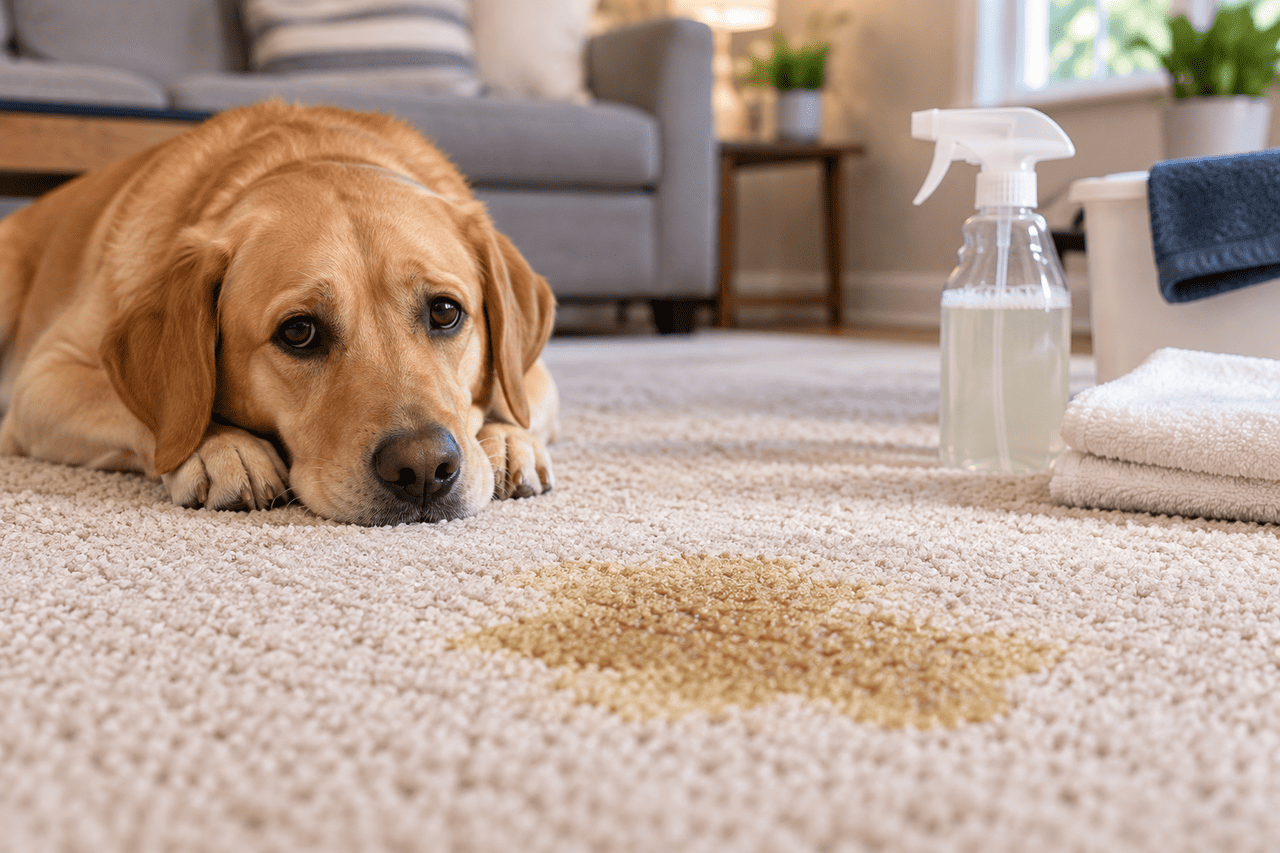
Dogs bring plenty of joy into a home, but even a well-trained dog can occasionally have an accident on the carpet.
Puppies are still learning. Older dogs may have accidents. A dog may also urinate indoors because of changes in routine, excitement, stress, or other circumstances. Whatever the reason, the important question for your carpet is the same: how do you clean the urine before the stain and smell become harder to remove?
Dog urine is more complicated than many ordinary spills because the visible spot is only part of the problem. Liquid can move through carpet fibers and potentially reach the carpet backing or padding underneath.
That is why spraying something fragrant over the surface may temporarily make the room smell better without actually resolving the source.
If you are wondering how to get dog pee out of carpet, the best approach depends on whether the accident is fresh or old, how much urine is present, and how deeply it has penetrated.
A spilled glass of water generally dries without leaving a strong lingering odor.
Dog urine is different.
It contains water along with various dissolved compounds and waste products. As urine dries and changes over time, residues can remain within the carpet.
If the urine reaches deeper layers, cleaning only the visible carpet fibers may leave some contamination behind.
This can result in several frustrating problems:
The sooner you respond to a fresh accident, the better your opportunity to remove moisture before it penetrates farther.
If you discover the accident while the carpet is still wet, act promptly.
Do not start by scrubbing.
Your first objective is to absorb as much urine as possible.
Place clean white towels or plain white paper towels over the wet area.
Press down firmly enough to absorb moisture.
Replace saturated towels with dry ones and continue blotting.
If necessary, apply pressure using a clean towel so moisture is drawn upward into the absorbent material.
Avoid rubbing from side to side.
Rubbing can spread the affected area and disturb the carpet fibers.
The visible center of the accident may not represent the entire affected area.
Liquid can spread outward as it moves through carpet.
Blot around the edges as well as the center.
Once you have absorbed as much liquid as possible, use a carpet-compatible pet urine product according to its directions.
Products designed specifically for pet accidents are generally a better choice than randomly combining household cleaning ingredients.
If you are using a new product, check whether it is appropriate for your carpet and test it in an inconspicuous area when recommended.
Do not assume that immediately wiping a product away will produce the best result.
Some products require a particular contact time.
Follow the label.
Using too much product, leaving it indefinitely, or mixing it with another cleaner is not necessarily more effective.
Once the treatment process is complete, remove excess moisture according to the product instructions and allow the carpet to dry thoroughly.
Good airflow can help.
Avoid leaving the carpet unnecessarily saturated.
For many homeowners, the stain is not the biggest concern.
It is the smell.
Dog urine odor can remain even when the carpet looks clean.
This happens because the odor source may extend deeper than the visible surface.
A successful odor-removal process needs to address the urine residue rather than simply cover the smell with fragrance.
Room sprays, carpet fragrances, and scented powders can temporarily change what you smell.
They do not necessarily remove the urine residue.
Once the fragrance fades, the urine odor may return.
If a dog has had repeated accidents, there may be more than one urine spot.
Treating one obvious stain may not resolve the room's overall odor if other affected areas remain.
A product formulated specifically for pet urine may help break down odor-producing residues when used correctly.
Follow the manufacturer's instructions carefully.
If a significant amount of urine has penetrated the carpet, the backing or padding may also be involved.
Surface treatment alone may not be sufficient in a severe or repeated-accident situation.
Old dog urine presents a different challenge from a fresh accident.
By the time you discover an older stain, much of the original moisture has evaporated.
However, residues may remain.
You may notice:
Old stains generally require more than simply blotting with water.
If you can see the stain, this is straightforward.
If you can smell urine but cannot identify the exact location, inspect the carpet carefully rather than treating the entire room with random cleaning products.
Professional cleaners may also use specialized inspection methods when evaluating pet-related problems.
Before applying another product, think about what has already been used.
Have you tried:
Repeatedly layering products can leave residues and complicate future treatment.
If several DIY methods have already failed, professional evaluation may be the better next step.
Enzyme-based or biological pet-cleaning products are commonly used for urine accidents.
These products are designed to act on components associated with organic stains and odors.
However, effectiveness depends on factors such as the specific product, correct application, carpet compatibility, age of the accident, and depth of contamination.
Follow the manufacturer's directions rather than assuming that more product will produce better results.
Do not mix an enzyme cleaner with unrelated cleaning chemicals unless the manufacturer specifically states that doing so is safe.
Vinegar is one of the most common DIY suggestions for pet urine.
You will find countless homemade recipes online combining vinegar with water and sometimes other ingredients.
That does not mean vinegar is appropriate for every carpet or every urine problem.
Carpet fibers, dyes, backing materials, and manufacturer recommendations vary.
If you decide to use a homemade treatment, test it in an inconspicuous location first and avoid saturating the carpet.
More importantly, avoid continually adding different household substances if the odor remains.
At some point, additional DIY chemistry can become counterproductive.
Baking soda is frequently used because it can absorb odors and moisture.
It may help with some surface odor situations, but it should not be viewed as a guaranteed solution for urine that has penetrated into the carpet system.
If the source of the odor remains deeper in the carpet, padding, or another underlying material, treating only the top fibers may provide limited results.
Also make sure any product you apply to carpet can be removed appropriately afterward.
Hydrogen peroxide appears in many homemade pet-stain recipes.
It can also affect colors and materials.
Before applying peroxide to carpet, consider the possibility of discoloration and check the carpet manufacturer's recommendations.
Never assume a household product is safe simply because it is commonly recommended online.
A dark urine spot is frustrating, but permanently lightening the surrounding carpet can create an even more noticeable problem.
A small amount of mild detergent may assist with certain surface cleaning situations, but dog urine is not simply an ordinary dirt stain.
Using too much soap can leave residue behind.
That residue can make carpet sticky and contribute to rapid resoiling.
If you use a detergent-based spot cleaner, use an appropriate amount and remove the residue according to the product instructions.
Some common reactions can make the situation worse.
Scrubbing can spread contamination and distort carpet fibers.
Blot instead.
Pouring large quantities of water or cleaning solution onto the accident may carry moisture deeper into the carpet.
Use controlled amounts.
Avoid combining cleaners in an attempt to create a stronger solution.
Household chemicals can interact unpredictably, and carpet materials may be damaged.
A pleasant smell does not prove the urine has been removed.
One small puppy accident is different from months of repeated urination in the same room.
Repeated contamination can extend beyond the surface fibers.
Bleach can alter carpet color and is not an appropriate general-purpose solution for dog urine on carpet.
This is one of the most frustrating pet-carpet problems.
You clean the stain.
The room smells better.
Then the urine odor seems to return.
There are several possible explanations.
If urine reached the backing or padding, treating only the surface may leave some of the source behind.
Dogs may repeatedly use the same room or area.
One visible stain may not be the only source.
Excess detergent or DIY products can remain in carpet if they are not removed appropriately.
Applying excessive liquid during cleaning can create additional drying problems and spread contamination.
A scented product may temporarily overpower urine odor.
Once the fragrance dissipates, the original smell becomes noticeable again.
Yes.
Carpet is not a solid waterproof surface.
Enough liquid can move through the fibers and reach lower layers.
How far it travels depends on the amount of urine, carpet construction, padding, how quickly it is addressed, and whether accidents repeatedly occur in the same location.
This is an important distinction.
A small fresh accident treated promptly may be primarily a surface issue.
Repeated large accidents can become a deeper contamination problem.
Professional carpet cleaning can help with many pet-related stains and odors, but the result depends on the severity and depth of the problem.
A responsible cleaner should evaluate the situation rather than promise that every pet odor can be completely removed under every circumstance.
Factors that can affect the outcome include:
When calling a carpet cleaner, explain that the issue involves dog urine rather than simply requesting general carpet cleaning.
That gives the cleaner useful context before evaluating the carpet.
Pet ownership is common throughout Savannah and the surrounding communities, and occasional carpet accidents are part of life for many households.
When home treatments are no longer resolving the stain or smell, professional cleaning may be the next step.
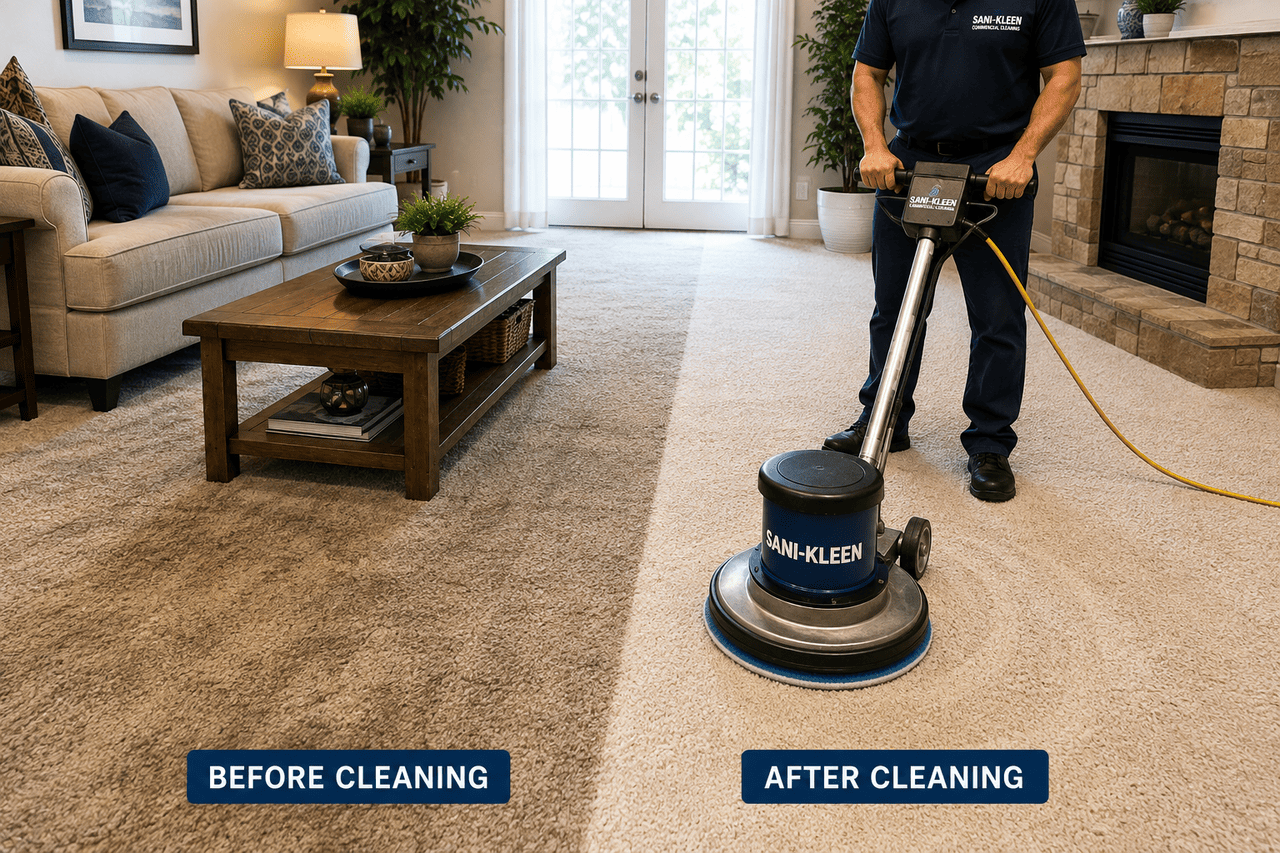
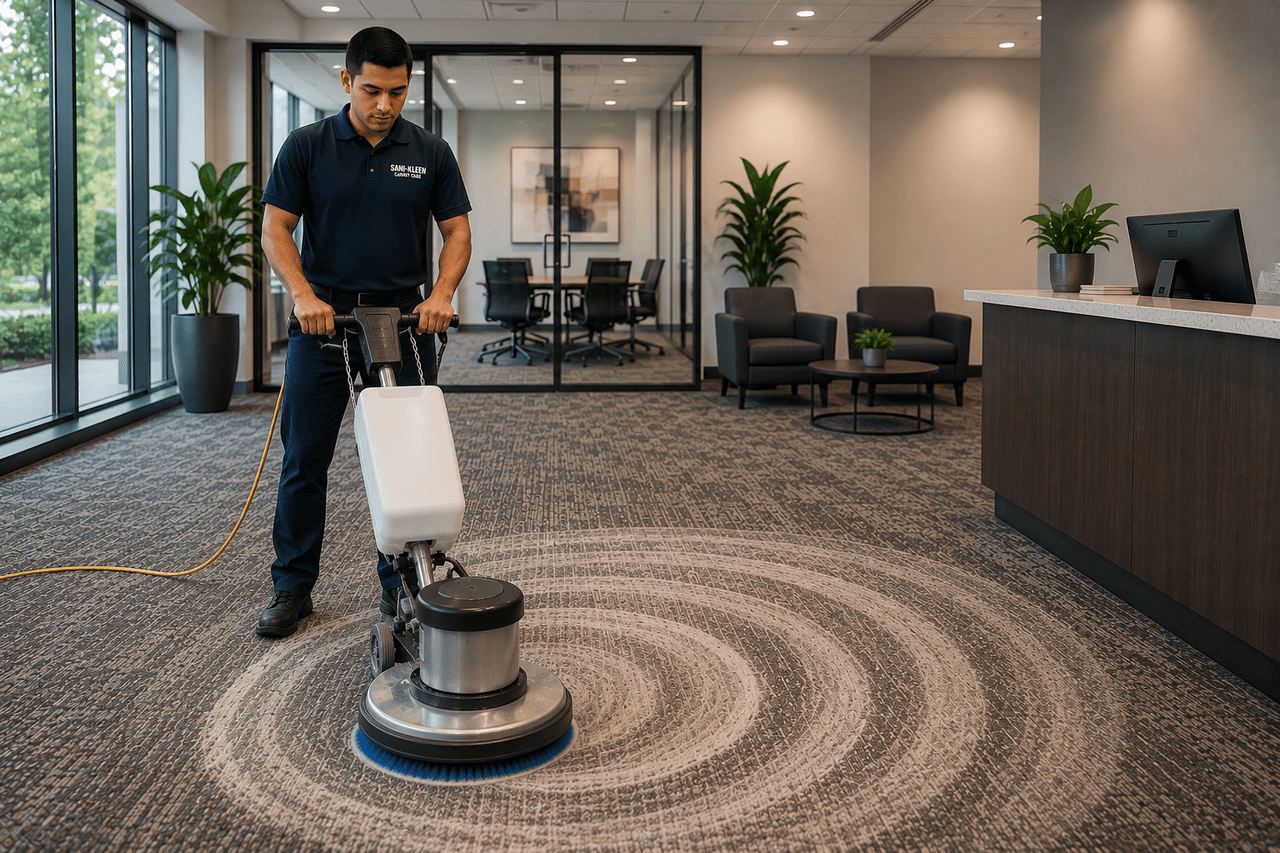
Sani-Kleen of Savannah LLC has provided carpet cleaning services in the Savannah area since 2003.
Our services include carpet cleaning, sanitizing and odor elimination, upholstery and furniture cleaning, and area rug cleaning.
We use eco-friendly, fast-drying cleaning methods to help customers maintain cleaner carpets without unnecessarily long drying periods.
If you contact us about a dog urine problem, let us know approximately how old the accidents are, whether they are isolated or repeated, and what cleaning products you have already used.
Sometimes you know a room smells like urine but cannot see an obvious stain.
Start with a careful visual inspection.
Look around:
Move furniture only when it can be done safely.
If there appear to be numerous affected areas or the source remains difficult to identify, professional inspection can help determine the extent of the problem.
Fast response makes a significant difference.
Do not allow fresh urine to remain in the carpet longer than necessary.
Blot immediately.
If accidents happen occasionally, keep clean white towels and an appropriate pet-urine product somewhere accessible.
Using excessive amounts can leave residue or add unnecessary moisture.
Follow directions.
If your dog continually urinates indoors, cleaning the carpet addresses the flooring problem, but it does not address why the accidents keep happening.
Depending on the circumstances, training assistance or veterinary guidance may be appropriate.
Homes with pets can accumulate hair, soil, spots, and odors more quickly than some pet-free homes.
Regular vacuuming combined with periodic professional cleaning can help maintain the carpet's overall appearance.
Yes.
A coffee spill, muddy footprint, and dog urine accident create different cleaning challenges.
Pet urine involves both visible staining and potential odor.
That is why simply making the carpet look clean is not always enough.
The source of the odor must also be considered.
This is particularly important when accidents are repeated.
Not every urine problem means carpet needs to be replaced.
Professional cleaning may be able to address many situations.
However, severe, long-term contamination involving deeper materials can require more extensive remediation than ordinary carpet cleaning.
The appropriate solution depends on what has been affected.
Before assuming replacement is necessary, have the condition evaluated.
At the same time, be cautious of anyone guaranteeing that a severe contamination problem can always be solved with a simple surface cleaning.
Urine accidents are only one part of maintaining carpet when you have pets.
Dogs also bring in:
Regular vacuuming is one of the simplest ways to control this accumulation.
Entry mats can also reduce the amount of soil tracked indoors.
Wiping muddy paws before your dog walks across the carpet can make a noticeable difference, especially during wet weather.
When spills or accidents happen, address them promptly instead of waiting for your next whole-room cleaning.
Start by blotting up as much urine as possible with clean white towels. Do not scrub. Once excess moisture has been absorbed, use an appropriate carpet-safe pet urine product according to its instructions.
Odor removal requires addressing the urine residue rather than simply covering the smell with fragrance. Pet-urine products may help with surface contamination, while deeper or repeated accidents may require professional evaluation.
Older urine can be more difficult because residues may remain after the moisture has dried. Locate the affected areas, avoid layering multiple DIY products, and consider professional cleaning if carpet-safe pet treatments do not resolve the odor.
Baking soda may help absorb some odors, but it cannot be assumed to eliminate urine contamination that has penetrated into deeper carpet layers.
Vinegar is commonly included in DIY pet-cleaning methods, but results vary and it is not appropriate to assume every homemade solution is safe for every carpet. Follow carpet-care recommendations and avoid mixing multiple cleaning chemicals.
Some urine stains can become difficult or impossible to remove completely, particularly when they are old, repeatedly treated incorrectly, or have affected carpet dyes or fibers. Prompt treatment generally gives you a better opportunity for improvement.
The urine may have dried without leaving an obvious visible mark, there may be multiple small accident areas, or contamination may exist below the carpet surface.
Professional cleaning can help address many pet urine stains and odors. Results depend on the extent, age, location, carpet construction, previous treatments, and whether urine has reached underlying materials.
Consider professional carpet cleaning when:
The goal should be to solve the underlying carpet problem rather than continually adding fragrance or cleaner to the surface.
If dog accidents have left your carpet stained or smelling unpleasant, Sani-Kleen of Savannah LLC can help evaluate the affected areas and determine an appropriate cleaning approach.
We provide residential carpet cleaning throughout Savannah and surrounding communities, including Pooler, Richmond Hill, Port Wentworth, Garden City, Wilmington Island, Tybee Island, Rincon, Springfield, Guyton, and Skidaway Island.
Sani-Kleen has served the Savannah area since 2003 and offers eco-friendly, fast-drying carpet-cleaning services.
Our current carpet-cleaning special is 3 Rooms & a Hallway for $130.
Call Sani-Kleen of Savannah at (912) 414-0652 to request a quote or schedule carpet cleaning.



%20(1).png)