.png)
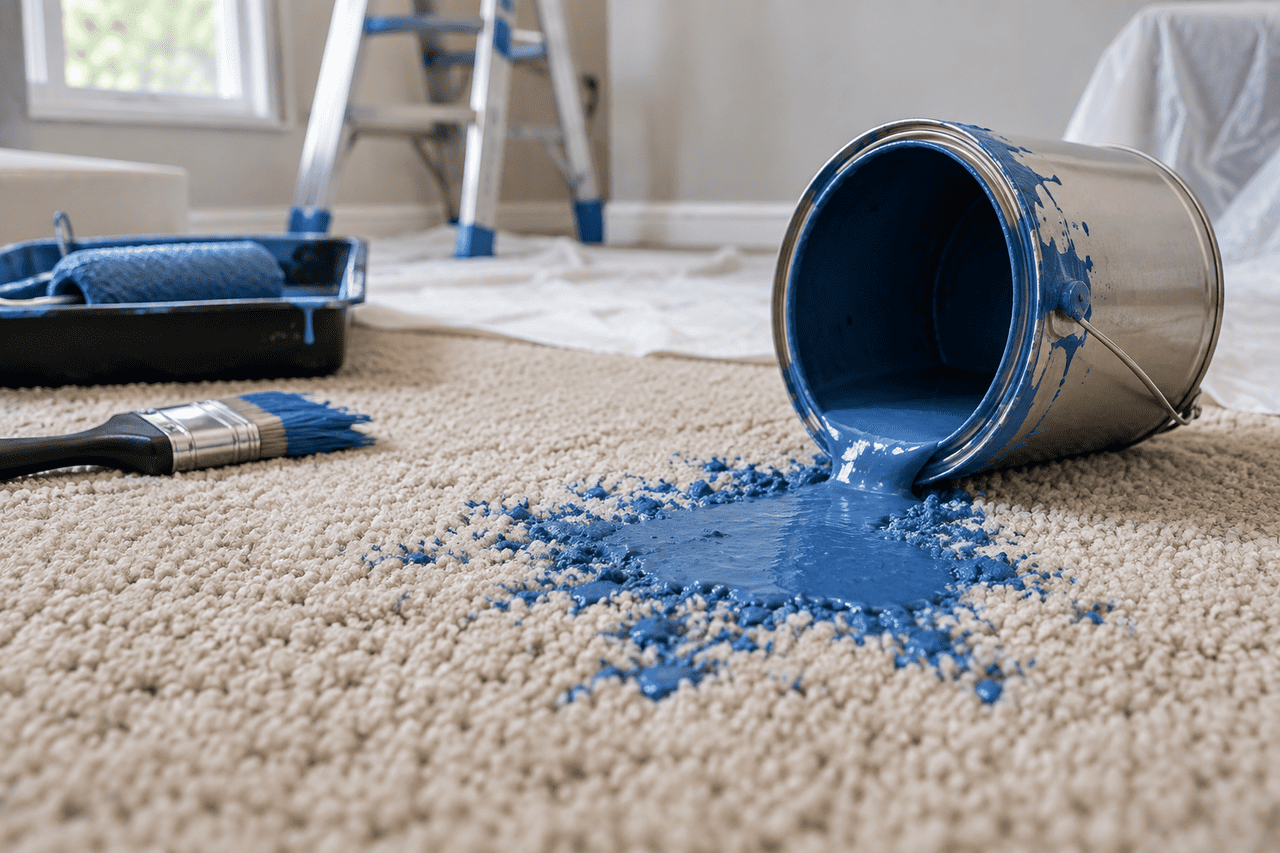
A paint spill on carpet can look like a disaster, especially when a bright color lands on light-colored fibers. Whether you are touching up a bedroom wall, completing a weekend DIY project, or renovating an entire room, it only takes one tipped paint container or overloaded brush to create a difficult carpet stain.
The good news is that some paint spills can be successfully treated, particularly when you act quickly.
The correct method depends heavily on the type of paint involved. Water-based latex paint is not treated exactly the same way as oil-based paint, and fresh paint requires a different approach from paint that has already dried.
Using the wrong cleaner or aggressively scrubbing the area can also turn a manageable spot into permanent carpet damage.
If you are wondering how to get paint out of carpet, start by identifying the paint, determine whether it is wet or dry, and proceed carefully.
Before applying anything to your carpet, check the paint container if it is still available.
Look for terms such as:
The label may also contain cleanup instructions.
This matters because paint formulations are different. A cleaning method that works reasonably well for a water-based product may be ineffective or inappropriate for an oil-based product.
If you do not know what type of paint caused the stain, avoid immediately applying strong solvents.
Fresh paint usually gives you the best opportunity for successful removal.
The first objective is to remove as much excess paint as possible before it spreads or dries.
If there is a puddle or thick layer of paint sitting on the carpet, carefully lift away the excess.
A spoon or another dull-edged tool may help.
Work gently.
Try to lift the paint upward rather than pushing it deeper into the fibers.
Do not use a sharp knife or blade that could cut the carpet.
Once the excess paint has been removed, use a clean white cloth or plain white paper towel to blot the area.
Avoid aggressive back-and-forth rubbing.
Scrubbing can spread wet paint into surrounding fibers and potentially damage the carpet's texture.
Work from the outside edge toward the center of the spill.
This helps contain the affected area.
At this point, your next step depends on whether the paint is water-based or oil-based.
Do not simply reach for the strongest cleaner available.
Latex paint is commonly used for interior walls and ceilings. Many modern latex paints are water-based, which can make a fresh spill easier to address than some solvent-based paints.
If the paint is still wet:
Do not pour a large quantity of water directly onto the carpet.
The objective is to gradually transfer the paint from the carpet onto the cloth, not to flood the stain.
Acrylic paint is frequently used for crafts, artwork, furniture projects, and decorative applications.
Fresh water-based acrylic paint may respond to careful blotting and an appropriate mild cleaning solution.
Start by removing excess paint without spreading it.
Then use a clean white cloth to blot the affected fibers.
A small amount of mild dishwashing liquid diluted with water may be suitable for some carpets and water-based acrylic paints. Test any solution in an inconspicuous area first.
Continue alternating between careful treatment and blotting.
Avoid saturating the carpet.
Once acrylic paint dries, removal can become considerably more difficult because the paint forms a film.
Finding a dried paint spot several hours or days after a project presents a different challenge.
Do not immediately start pulling or scraping aggressively.
Dried paint may have bonded around multiple carpet fibers, and forceful removal can damage them.
If there is a thick piece of dried paint sitting above the carpet surface, use a dull-edged tool to gently loosen what can be removed without pulling the fibers.
Work slowly.
The objective is to break away excess material, not cut or tear the carpet.
If you still have the original paint container, check whether it is water-based, latex, acrylic, or oil-based.
This will guide the next step.
For compatible carpet and water-based paint, a controlled amount of moisture may help soften dried residue.
Use a damp cloth rather than pouring water directly onto the stain.
Allow the moisture a little time to interact with the dried paint, then gently blot and lift loosened material.
You may need to repeat the process.
Patience is much safer than aggressive scrubbing.
If the paint is not responding, do not automatically move to harsher chemicals.
This is particularly important if you have valuable carpet, natural fibers, uncertain dyes, or a large stain.
Professional evaluation may be preferable to permanent carpet damage.
Oil-based paint requires considerably more caution.
Water alone generally will not provide the same cleanup behavior as it can with fresh water-based paint.
The paint manufacturer's label may specify a particular solvent for tool cleanup. However, that does not automatically mean the same solvent is safe to apply freely to carpet.
Strong solvents can potentially affect:
There may also be ventilation, flammability, and safety considerations.
If you have a significant oil-based paint spill on carpet, professional assistance is often the safer choice.
If you decide to use a carpet-compatible product yourself, follow the product and carpet manufacturer's directions carefully, provide appropriate ventilation, and test it in an inconspicuous area first.
Never mix cleaning chemicals or solvents.
A mild dishwashing solution can be useful for certain fresh water-based paint spills.
The key word is mild.
You do not need to create a bucket full of concentrated soap.
Too much detergent can leave residue in the carpet. That residue may make the fibers feel sticky and attract soil later.
Use a small amount diluted in water and apply it with a cloth rather than pouring it directly onto the carpet.
Afterward, carefully blot with a separate cloth lightly dampened with clean water.
Vinegar is frequently suggested online as a household carpet cleaner.
However, it should not be treated as a universal solution for paint.
Paint chemistry varies, as do carpet fibers and dyes.
Rather than experimenting with several homemade solutions, first identify the paint and consult the carpet and cleaning-product instructions.
The goal is not simply to dissolve the paint. You also need to protect the carpet underneath it.
Isopropyl alcohol is sometimes suggested for certain dried water-based or acrylic paint residues.
However, applying a solvent to carpet requires caution.
A product that helps loosen one substance may also affect dyes, adhesives, backing, or other carpet components.
If you are considering any solvent-based spot treatment, first verify that it is compatible with your carpet and test it in an inconspicuous area.
Never assume that because a product is commonly found in the home, it is automatically safe for every carpet.
Paint thinner should not be your automatic solution to a carpet stain.
Paint thinners and other strong solvents can introduce several problems, including possible damage to carpet materials and safety concerns related to fumes or flammability.
If an oil-based paint requires solvent treatment, it may be time to contact a professional rather than experimenting with a large visible area of carpet.
More aggressive chemistry is not necessarily better cleaning.
Paint stains often become worse because of the initial reaction to the spill.
Avoid these common mistakes.
Scrubbing spreads paint horizontally across the carpet and may drive it deeper into the fibers.
Blot and lift instead.
Flooding a paint stain can spread diluted paint into a much larger area.
Control the amount of moisture you introduce.
It may be tempting to cut dried paint from the carpet.
Doing so can permanently damage the fibers and leave an obvious patch even if the paint itself disappears.
Combining household cleaners, stain removers, solvents, or other chemicals can be unsafe and may damage your carpet.
Use one appropriate treatment at a time and follow its instructions.
Bleach may alter the carpet's color rather than simply removing the paint.
A bleached patch can be more noticeable than the original stain.
If a conservative treatment is not working, repeatedly escalating to harsher chemicals can make professional stain treatment more complicated.
Sometimes the best decision is knowing when to stop.
A small surface spot and an entire spilled paint container are very different situations.
When a large volume of paint penetrates through the fibers, it may reach the carpet backing or material underneath.
At that point, surface blotting may not address the entire problem.
The extent of the spill, carpet construction, paint type, and amount of penetration all matter.
A large paint spill is a strong reason to seek professional advice.
Professional carpet cleaning may improve or remove certain paint stains, but no responsible cleaner should guarantee every paint stain will disappear before evaluating it.
Results can depend on:
A fresh water-based paint spill is a different situation from months-old oil-based paint.
When contacting a professional, provide as much information as possible.
If you still have the paint container, keep it. Knowing exactly what product was spilled can be useful.
Painting and renovation projects are common sources of carpet stains.
A drop cloth shifts, a tray gets bumped, or someone walks through a small paint spot and tracks it across the room.
If a paint stain remains after careful home treatment, Sani-Kleen of Savannah LLC provides professional carpet cleaning for homes and businesses throughout Savannah and surrounding communities.
Sani-Kleen has served the Savannah area since 2003 and uses eco-friendly, fast-drying carpet-cleaning methods.
If you have already applied products to a paint stain, tell the cleaning technician what you used. This information can help when evaluating the spot and determining an appropriate approach.
Preventing a paint stain is much easier than removing one.
Before beginning your next painting project, take a few precautions.
Cover the entire working area rather than only the section directly underneath the wall.
Paint can drip from brushes, rollers, trays, ladders, and clothing.
A loose drop cloth can shift as you walk.
Secure coverings appropriately so exposed carpet does not suddenly appear in the middle of the project.
Do not place open paint cans or trays where people need to step around them repeatedly.
A tiny fresh drip may be relatively easy to address.
That same drip can become significantly harder to remove after it dries.
Paint on the bottom of a shoe can create multiple spots before you realize what happened.
Inspect footwear before walking out of the work area.
Paint on shoes or pet paws can create a trail of small spots across carpet.
When this happens, avoid walking through the affected areas while you gather cleaning supplies.
Address fresh spots promptly and work methodically.
If there are many spots, professional cleaning may be more practical than treating each one with a different amount of DIY cleaner.
Not necessarily.
If the carpet is otherwise clean and you successfully treat a small fresh spot, full-room cleaning may not be required.
However, spot cleaning can sometimes leave the treated area looking different from the surrounding carpet, particularly when the rest of the carpet contains accumulated soil.
If you already have noticeable traffic lanes, multiple stains, pet-related spots, or general discoloration, it may make sense to professionally clean the room after the paint problem has been addressed.
Drying time varies depending on how much moisture was used, carpet construction, indoor humidity, airflow, and other conditions.
This is one reason to avoid saturating the area during DIY treatment.
Use dry towels to absorb as much remaining moisture as possible and provide reasonable airflow.
If the carpet remains unusually wet because a large amount of liquid was used, further evaluation may be necessary.
Sometimes. The result depends on the paint type, whether it is wet or dry, the carpet fiber, the amount spilled, and previous cleaning attempts. Fresh water-based paint is generally a more favorable situation than a large, old, oil-based spill.
Start by carefully removing excess paint, then blot with clean white towels. If it is water-based paint and your carpet allows it, controlled treatment with water and a small amount of appropriate mild cleaning solution may help.
Carefully loosen removable dried material with a dull-edged tool. For compatible water-based paint, controlled moisture may help soften the remaining residue. Avoid cutting the carpet or aggressively scraping the fibers.
Fresh water-based acrylic paint should be blotted promptly after excess paint is removed. A mild carpet-compatible cleaning solution may help. Dried acrylic paint can be more difficult and may require professional treatment.
Fresh water-based latex paint can often be approached by removing excess paint, blotting, and carefully using a small amount of water or an appropriate mild cleaning solution. Avoid flooding or scrubbing the area.
Do not assume paint thinner is safe for your carpet. Strong solvents may affect fibers, dyes, backing, adhesives, and indoor safety. For significant oil-based paint stains, professional advice is often preferable.
It may improve or remove certain dried paint stains, but the outcome depends on the type of paint, carpet, stain age, and previous treatments. An inspection is the best way to determine what may be possible.
No. Aggressive scrubbing can spread wet paint and disturb carpet fibers. Blotting, lifting, and controlled treatment are safer approaches.
Small, fresh water-based paint spills may respond well to careful home treatment.
Large spills, dried paint, unknown paint products, delicate carpet, and oil-based paints can be much more challenging.
If your initial conservative treatment does not work, stop before escalating to increasingly aggressive chemicals.
Permanent fiber or color damage is much harder to correct than the original stain.
If paint, dirt, pet stains, spills, or other spots are making your carpet look worn, Sani-Kleen of Savannah LLC can help.
We provide residential and commercial carpet cleaning throughout Savannah and surrounding communities, including Pooler, Richmond Hill, Port Wentworth, Garden City, Wilmington Island, Tybee Island, Rincon, Springfield, Guyton, and Skidaway Island.
Our eco-friendly, fast-drying approach is designed to clean carpets without unnecessarily long drying periods.
Sani-Kleen currently offers 3 Rooms & a Hallway for $130.
Call Sani-Kleen of Savannah at (912) 414-0652 to request a quote or schedule your carpet cleaning.
.webp)
.webp)
.webp)
.webp)



%20(1).png)