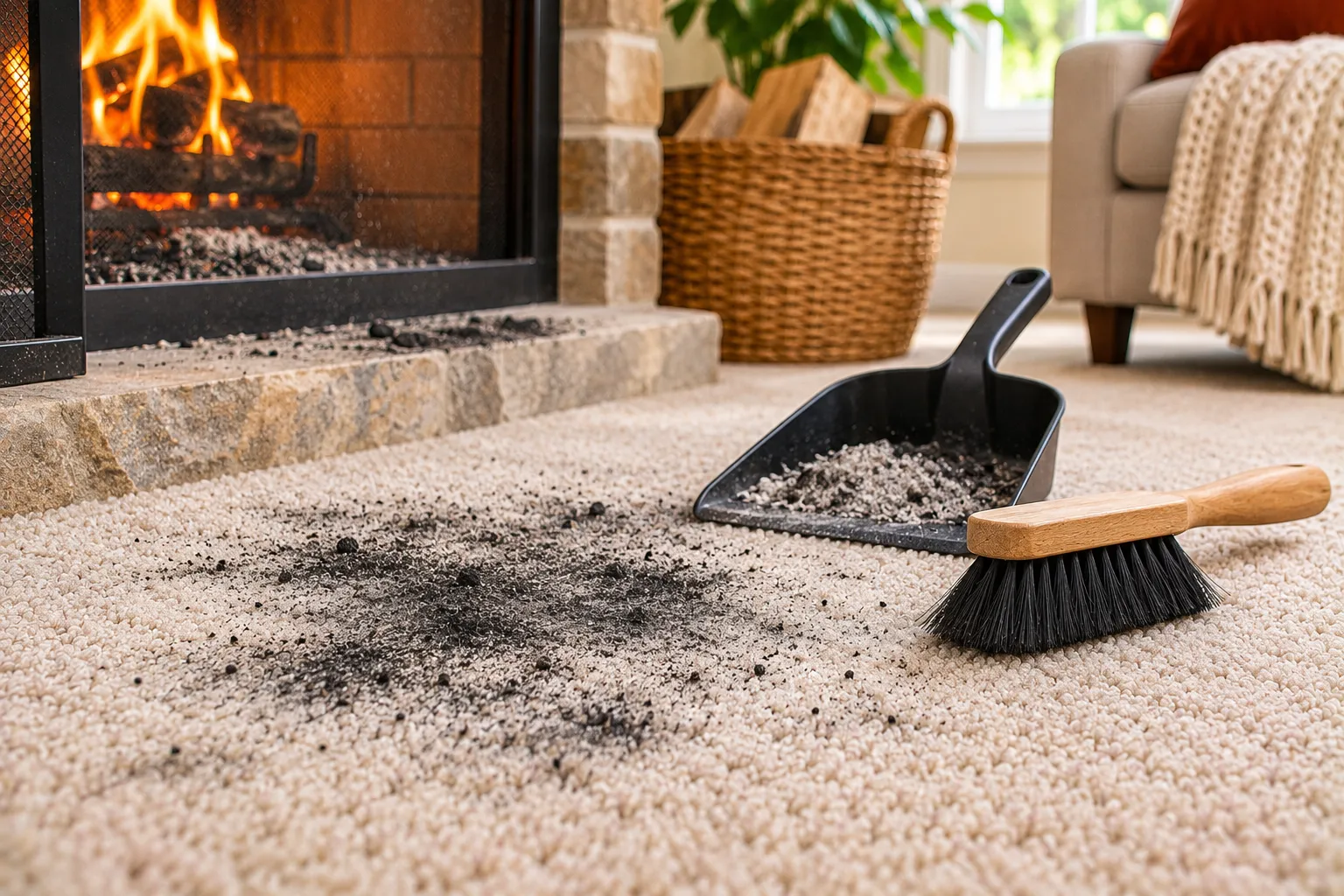
A little soot can create a surprisingly big mess. One moment you're cleaning around a fireplace or moving a candle, and the next, black powder is scattered across your carpet.
Unlike ordinary dirt, soot consists of extremely fine particles that can cling to carpet fibers and spread when disturbed. A small dark patch can quickly become a larger gray or black stain if you rub it, step on it, or try to wash it away before removing the loose particles.
The good news is that some minor soot deposits can be cleaned successfully with careful techniques. However, the right approach depends on where the soot came from, how much is present, and what type of carpet you have.
The most important rule for removing soot from carpet is to avoid rubbing or wetting loose soot before it has been safely collected.
In this guide, you'll learn how to get soot out of carpet, handle fireplace ash, address candle-related black marks, and recognize when the situation requires professional cleaning or specialized fire-restoration services.
Soot is a collection of fine particles produced during incomplete combustion.
It can come from sources such as fireplaces, candles, wood-burning appliances, and fires.
Depending on its source, soot may contain carbon-rich particles, oils, and other combustion residues.
When soot lands on carpet, its fine particles can settle between individual fibers.
Several factors make soot difficult to remove:
The source of the soot matters.
A small amount of cooled fireplace residue near a hearth is not the same as widespread contamination after a structure fire.
Before attempting any cleaning, identify the source.
If the soot came from a house fire, significant smoke incident, malfunctioning heating appliance, or unknown combustion source, do not treat it as an ordinary carpet stain.
Fire-related residues can contain hazardous substances, and the affected area may require specialized assessment and restoration.
If a fireplace, furnace, or other fuel-burning appliance is producing unexpected soot, stop using it and arrange an appropriate inspection.
Soot deposits accompanied by unusual odors, smoke, or signs of poor combustion may indicate an appliance or ventilation problem.
For a small, isolated deposit of ordinary, fully cooled fireplace soot, cautious cleaning may be reasonable.
For widespread contamination, consult a qualified fire-and-smoke restoration professional.
Your first response can determine whether the stain stays small or spreads.
Prevent foot traffic through the affected area.
Shoes and paws can carry soot into surrounding carpet.
Avoid brushing, scrubbing, or wiping loose soot.
These actions can push particles deeper into the fibers.
Water can cause fine soot particles to smear and become more difficult to collect.
Remove loose contamination first.
If soot or ash came from a fireplace, make sure it is fully cooled.
Fireplace ash can retain heat longer than expected.
Never vacuum or handle hot embers or potentially hot ash.
A few dry particles may be manageable.
A large deposit, heavy smoke residue, or contamination from a fire requires a different response.
For soot collection, specialized equipment with suitable filtration may be necessary.
An ordinary household vacuum is not always appropriate for fine soot or ash.
For a small, dry soot deposit from a known, nonhazardous source, the following approach can help limit spreading.
Do not begin cleaning until the material is fully cool.
If there is any possibility of hot embers, stop.
Do not shake rugs, sweep vigorously, or brush the carpet.
These actions can send particles into the air.
A vacuum specifically suitable for fine soot or ash, with appropriate filtration, may be used according to its manufacturer's instructions.
Do not assume a standard household vacuum is suitable.
Fine particles can pass through inadequate filtration, potentially spreading contamination.
After loose material has been collected, check whether a black or gray stain remains.
If the carpet manufacturer permits it, use a product appropriate for the carpet material and remaining residue.
Follow the product instructions and test in an inconspicuous area when recommended.
Use a clean white cloth.
Work carefully from the outside toward the center.
Follow the product's instructions for removing remaining cleaner.
Avoid excessive moisture.
Provide appropriate airflow.
Inspect the area once it is dry.
If dark discoloration remains, additional treatment may be needed.
Fireplace soot is one of the most common sources of black residue near a hearth.
It can appear when ash is disturbed, fireplace tools are moved, or logs are handled.
Determine whether you're dealing with dry ash, fine soot, or larger pieces of debris.
Do not assume recently removed ash is cool.
Wait until it is completely safe to handle.
Using a broom near the hearth can scatter fine particles.
Use equipment appropriate for fully cooled ash or soot.
Follow the equipment manufacturer's instructions.
Once loose material is removed, use a compatible carpet-cleaning method for any remaining mark.
If the affected area is extensive, professional assistance may be preferable.
Ash and soot are related, but they are not identical.
Ash often contains larger mineral particles left after combustion, while soot commonly consists of finer carbon-rich particles.
Both can create dark marks on carpet.
For a minor spill of fully cooled ash:
Never use a standard vacuum on ash that may contain hot embers.
Candles can produce soot, particularly when combustion is incomplete.
Soot may collect near candle holders or settle on nearby surfaces.
If candle soot reaches the carpet, begin by determining whether the deposit is dry soot or a mixture of soot and wax.
These require different approaches.
Avoid rubbing.
Collect loose particles with appropriate equipment.
Do not assume a dry-soot cleaning method will remove the wax.
Wax may require separate treatment.
Avoid applying high heat or strong solvents without confirming carpet compatibility.
Use an appropriate carpet-safe spot treatment or seek professional advice.
If a candle is producing excessive soot, discontinue using it until the cause has been addressed.
Black soot can be especially noticeable on white, cream, and beige carpeting.
However, a light carpet does not automatically justify using bleach.
Chlorine bleach can damage carpet fibers and alter dyes or finishes.
Start by removing loose particles safely.
Avoid spreading the residue.
Once the loose soot is gone, assess whether discoloration remains.
Use only a cleaning product compatible with the carpet.
If the stain persists, professional spot treatment may be appropriate.
White carpet can make even a small soot deposit appear severe.
The first priority is to prevent the stain from expanding.
Avoid scrubbing.
Do not pour water directly onto loose soot.
Use appropriate equipment to collect loose particles.
For remaining discoloration, follow the carpet manufacturer's cleaning instructions.
Avoid unverified household chemical mixtures.
Some soot stains may require specialized treatment, and complete removal is not guaranteed.
Wool carpeting requires extra caution.
Natural fibers can be sensitive to certain chemicals, excessive moisture, and aggressive agitation.
Fine soot particles may become trapped within the wool pile.
Avoid vigorous brushing or scrubbing.
Do not apply strong household cleaners without verifying compatibility.
For valuable wool carpeting or extensive soot contamination, professional evaluation is generally the safer option.
Area rugs vary considerably in construction.
A synthetic machine-made rug may respond differently from a handmade wool or antique rug.
If soot settles on an area rug:
If the rug was exposed to significant smoke or fire, specialized restoration may be required.
Vacuuming may help collect loose soot, but the type of vacuum matters.
Fine soot particles can pass through inadequate filtration.
A standard household vacuum may spread particles or become contaminated.
For small, fully cooled deposits, use only equipment specifically suitable for the material and follow its instructions.
For widespread soot, fire-related residue, or uncertain contamination, consult a qualified restoration professional.
Never vacuum hot ash or embers.
Baking soda is often recommended for household odors and stains.
However, it does not reliably remove soot particles or the oily components that may accompany them.
Sprinkling baking soda over loose soot can create additional powder that must be collected.
It may also complicate cleanup if the materials become mixed.
For soot, appropriate dry collection is generally more important than adding household powders.
Vinegar is frequently suggested in homemade cleaning recipes.
However, it is not a universal soot remover.
Some soot contains oily or sticky residues that may not respond effectively to vinegar.
Applying liquid too early can also spread fine particles.
Before using any acidic cleaner, check the carpet manufacturer's recommendations.
Never mix vinegar with chlorine bleach.
A small amount of mild detergent may help with some oily residues on compatible synthetic carpeting.
However, dish soap should not be applied directly to a loose soot deposit.
First, remove loose particles using appropriate equipment.
Then evaluate the remaining stain.
If the carpet permits water-based cleaning, use only a small amount of compatible cleaning solution.
Avoid excessive detergent and moisture.
Remove cleaning residue according to the product instructions.
Hydrogen peroxide is sometimes suggested for dark stains because it can affect certain colored compounds.
However, it can also alter carpet dyes.
It is not a substitute for removing soot particles.
Using peroxide without confirming compatibility may cause permanent discoloration.
Avoid experimenting with peroxide on wool, dark-colored carpet, or specialty rugs without appropriate guidance.
Soot can smear because its particles are extremely fine.
Some deposits also contain oily components.
When rubbed or mixed with liquid, the particles may spread across a larger area.
This is why dry collection is often the first step for minor soot deposits.
If a soot stain begins spreading during cleaning, stop.
Allowing the problem to expand can make further treatment more difficult.
Sometimes the loose soot disappears, but a dark mark remains.
Possible reasons include:
Allow the carpet to dry completely before evaluating the result.
If the stain persists, professional treatment may be appropriate.
Yes.
Some soot deposits can leave permanent discoloration.
The outcome depends on:
A small deposit of dry fireplace soot may be easier to address than widespread contamination from a fire.
Complete removal cannot be guaranteed.
Several common mistakes can make the problem worse.
Rubbing can push fine particles deeper into the carpet.
Water can cause soot to smear.
Hot ash and embers create a fire risk.
Fine soot may require specialized filtration.
Bleach can damage carpet fibers and dyes.
Combining cleaning products can create safety risks.
Large or fire-related soot deposits may require specialized restoration.
Professional carpet cleaning may improve or remove certain minor soot stains.
However, results depend on the source, severity, carpet material, and previous treatments.
Routine carpet cleaning is not necessarily sufficient for widespread smoke or fire contamination.
Specialized fire-and-smoke restoration may be required.
If the soot came from a major fire or unknown source, contact a qualified restoration professional rather than treating it as an ordinary carpet-cleaning job.
For isolated carpet stains from everyday household sources, a professional carpet cleaner may be able to evaluate suitable treatment options.
Carpets can collect many types of household soil and stains, including dirt, food spills, pet-related residue, and occasional fireplace debris.
When ordinary cleaning does not restore the carpet's appearance, professional carpet cleaning may help.
Sani-Kleen of Savannah LLC has provided carpet-cleaning services throughout the Savannah area since 2003.
Our services include:
We use eco-friendly, fast-drying cleaning methods to help refresh carpets and maintain their appearance.
For an isolated carpet stain, contact Sani-Kleen to discuss the affected area and whether our services are appropriate.
For significant fire damage or widespread soot contamination, seek a qualified fire-restoration specialist.
A few precautions can reduce the risk of soot spreading.
A properly fitted screen can help contain debris.
Do not move ash until it is completely cool.
Use appropriate tools and containers.
Avoid placing soot-covered tools directly on carpet.
Follow the appliance manufacturer's maintenance instructions.
Arrange professional inspection or chimney service when appropriate.
Use methods suitable for collecting fine particles without dispersing them.
Prevent accidental tracking of residue into nearby rooms.
Candles can also contribute to soot deposits.
To reduce the risk:
These precautions can help reduce both soot accumulation and fire hazards.
For a small, dry deposit from a known source, avoid rubbing or wetting loose soot. Use equipment suitable for collecting fine particles, then treat remaining discoloration with a carpet-compatible cleaner.
Some loose soot can be collected with appropriate equipment. However, ordinary household vacuums may not provide suitable filtration. Never vacuum hot ash.
Allow any ash to cool completely, prevent foot traffic, collect loose particles safely, and treat remaining marks with a compatible carpet-cleaning product.
Baking soda does not reliably remove soot particles or oily combustion residue.
Vinegar is not a universal soot remover and may spread fine particles if applied before loose soot is collected.
Identify whether the deposit contains loose soot, wax, or both. Avoid rubbing and use a cleaning method appropriate for the material.
Yes. Some soot deposits can leave permanent discoloration, particularly when oily residue or deep contamination is involved.
Professional treatment may improve some isolated soot stains. Widespread fire-related contamination generally requires specialized restoration.
Consider professional assistance when:
For fire-related contamination, contact a qualified fire-and-smoke restoration professional.
For ordinary carpet-cleaning needs or isolated stains, a local carpet-cleaning company may be able to assess the situation.
If everyday dirt, food spills, pet accidents, or other household stains have left your carpet looking less than its best, Sani-Kleen of Savannah LLC can help.
We provide professional carpet cleaning throughout Savannah and surrounding communities, including Pooler, Richmond Hill, Port Wentworth, Garden City, Wilmington Island, Tybee Island, Rincon, Springfield, Guyton, and Skidaway Island.
Sani-Kleen has served the area since 2003 and offers eco-friendly, fast-drying carpet-cleaning services.
For an isolated soot mark, contact us to discuss whether carpet cleaning is suitable. For widespread fire or smoke damage, consult a qualified restoration specialist.
Call Sani-Kleen of Savannah at (912) 414-0652 to request a quote or schedule professional carpet cleaning.